• Link to Facebook
  • Link to X
  • Link to Youtube
  • Link to Rss this site
  • Link to Mail
  • Home
  • Reserved Area
  • Send contribution
  • Partners
  • People
  • Contacts
POnTE Project
  • About
    • Overview
    • Topics
    • Objectives
    • Work Packages
    • Consortium bodies
    • The Advisory Board
    • The Board of Stakeholders
  • Research
    • Project Reports
    • Project Deliverables
    • Project Publications
    • Featured Bibliography
  • Events
    • Meetings
    • Conferences
    • Technical workshops
  • Communication
    • News
    • Press review
    • Newsletter
    • Photo gallery
    • YouTube Channel
  • Factsheets
    • Xylella and Hemipteran vectors
    • CaLsol and Psyllid vectors
    • Hymenoscyphus fraxineus and Phythophtora
    • Project Outcomes
  • Protocols
    • Xylella and Hemipteran vectors
    • CaLsol and Psyllid vectors
    • Hymenoscyphus fraxineus and Phythophtora
  • Symptom Database
    • Xylella and Hemipteran vectors
    • CaLsol and Psyllid vectors
    • Hymenoscyphus fraxineus and Phythophtora
  • Bibliography
    • Xylella and Hemipteran vectors
    • CaLSol and Psyllid vectors
    • Hymenoscyphus fraxineus and Phytophthora
  • Legislation
    • Xylella and Hemipteran vectors
    • CaLsol and Psyllid vectors
    • Hymenoscyphus fraxineus and Phythophtora
  • Links
  • Click to open the search input field Click to open the search input field Search
  • Menu Menu
You are here: Home1 / NEWS2 / Xylella fastidiosa detected for the first time in Spain, on cheery trees...

Xylella fastidiosa detected for the first time in Spain, on cheery trees in Mallorca

23/11/2016/in NEWS

On November 10, 2016 the Government of the Balearic Island (GOIB) has officially announced the first detection of the quarantine pathogen Xylella fastidiosa in Spain, in the town of Manacor on the island of Mallorca. In the framework of routine inspections, three sweet cherry trees, growing in an open air nursery center in Porto Cristo (Mallorca) were found positive, as confirmed by qPCR tests performed at the National Reference Laboratory of IVIA. The MLST analysis carried out by IVIA, in collaboration with Dr. B. Landa (CSIC-IAS), identified the three isolates as belonging to the X. fastidiosa subsp. fastidiosa ST-1 strain. The infected plants, not showing peculiar symptoms of leaf scorch, were moved to Mallorca from another nursery in Tarragona (mainland Spain) in 2012, and before were imported from the Netherlands.

In accordance with the EC Implementing Decision (EU) 2016/764, the infected plants were destroyed and within a radius of 100 m around the garden center, all the plant species known to be susceptible to X. fastidiosa subsp. fastidiosa, i.e. oleander (Nerium oleander) and cherry (Prunus avium), will be uprooted in coming days.

To prevent the risks of a spreading of Xylella fastidiosa in the island, a contingency plan has been established by the Spanish Ministry of Agriculture (MAPAMA) and surveys on potential Xf-host plants in the areas surrounding the infected plants are being carried out.
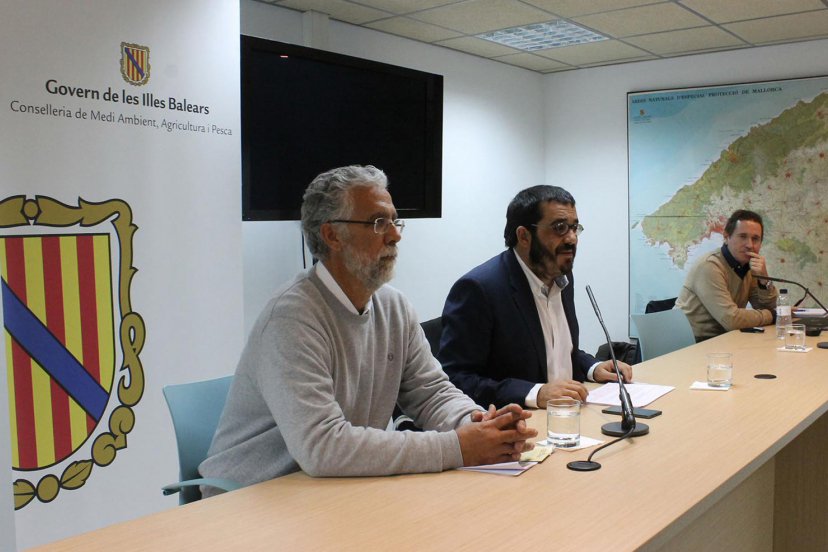
The Counselor V. Vidal accompanied by the Director General of Agriculture and Livestock, M. Ginard, and the Head of Plant Health Service, A. Joan, announces the detection of Xf in Spain.

The Counselor V. Vidal accompanied by the Director General of Agriculture and Livestock, M. Ginard, and the Head of Plant Health Service, A. Joan, announces the detection of Xf in Mallorca.


Tags: Mallorca, olive, Spain, Xylella
Share this entry
  • Share on Facebook
  • Share on X
  • Share on WhatsApp
  • Share on Pinterest
  • Share on LinkedIn
  • Share on Tumblr
  • Share on Vk
  • Share on Reddit
  • Share by Mail
https://www.ponteproject.eu/wp-content/uploads/2016/11/xylella-spain-mallorca-1.jpeg 552 828 Staff https://www.ponteproject.eu/wp-content/uploads/2016/10/PONTE-LOGO-JPEG-2.jpg Staff2016-11-23 12:41:562016-11-23 12:41:56Xylella fastidiosa detected for the first time in Spain, on cheery trees in Mallorca
You might also like
The University of Costa Rica organises a workshop on the Xylella fastidiosa host status of P. roebelenii palm
Brazilian scientist Alessandra de Souza visits CNR-IPSP lab to support WP7 tasks on Xf control
FAO-IPPC-CIHEAM International workshop on Xylella fastidiosa
Boscia-presents-POnTE-fao-ippc Researchers from POnTE Consortium enliven the opening day of FAO-IPPC-CIHEAM workshop on Xylella
europarliament-agriculture-committee Agriculture committee endorses new rules to protect EU countries from Xylella and newly identified pest risks
DIARIO DE GASTRONOMIA.COM | Proyecto internacional para prevenir la ‘Xylella fastidiosa’ del olivo
Popular
  • Two upcoming courses promote innovative diagnostics for...05/09/2016 - 10:51
  • NEWSLETTER | ISSUE 23 | November 9, 201609/11/2016 - 15:00
  • Rome
    Rome kick-off meeting launched Consortium activities29/12/2015 - 11:25
  • EC.EUROPA.EU|Start of a new EU-funded project on solutions...29/12/2015 - 16:40
Recent
  • Estimating the epidemiology of emerging Xylella fastidiosa...02/07/2020 - 10:58
  • Assessment of the efficiency of different control programs...18/06/2020 - 09:51
  • A biological control model to manage the vector and the...01/05/2020 - 12:44
  • Economic impact of Xylella fastidiosa in European olive...15/04/2020 - 11:22
Comments
Tags
ANSES Apulia Ash dieback Balearics Candidatus Liberibacter Solanacearum CIHEAM Citoliva CNR CoDiRO Comunitat Valenciana Corsica CSIC Diagnostics EFSA Epidemiology EPPO EU Euphresco European Commission EuroXanth FAO Forestry Horizon 2020 Hymenoscyphus fraxineus INRA Insect vectors IPPC IVIA Mallorca Newsletter olive Olive Quick Decline Syndrome Philaenus spumarius Phytophthora POnTE psyllids SASA Spain Symptoms Transcriptome UNIBA University of Belgrade XF-ACTORS Xf tolerance Xylella

Subscribe to our Newsletter

©2025 Developed by Signum Srl
  • Link to Facebook
  • Link to X
  • Link to Youtube
  • Link to Rss this site
  • Link to Mail
Link to: Society, science, and Facebook: Xylella fastidiosa as a case study Link to: Society, science, and Facebook: Xylella fastidiosa as a case study Society, science, and Facebook: Xylella fastidiosa as a case study Link to: NEWSLETTER | ISSUE 25 | November 23, 2016 Link to: NEWSLETTER | ISSUE 25 | November 23, 2016 NEWSLETTER | ISSUE 25 | November 23, 2016
Scroll to top Scroll to top Scroll to top

This site uses cookies. By continuing to browse the site, you are agreeing to our use of cookies.

ACCEPTDECLINEINFO

Cookie and Privacy Settings


How we use cookies

We may request cookies to be set on your device. We use cookies to let us know when you visit our websites, how you interact with us, to enrich your user experience, and to customize your relationship with our website.

Click on the different category headings to find out more. You can also change some of your preferences. Note that blocking some types of cookies may impact your experience on our websites and the services we are able to offer.

Essential Website Cookies

These cookies are strictly necessary to provide you with services available through our website and to use some of its features.

Because these cookies are strictly necessary to deliver the website, refusing them will have impact how our site functions. You always can block or delete cookies by changing your browser settings and force blocking all cookies on this website. But this will always prompt you to accept/refuse cookies when revisiting our site.

We fully respect if you want to refuse cookies but to avoid asking you again and again kindly allow us to store a cookie for that. You are free to opt out any time or opt in for other cookies to get a better experience. If you refuse cookies we will remove all set cookies in our domain.

We provide you with a list of stored cookies on your computer in our domain so you can check what we stored. Due to security reasons we are not able to show or modify cookies from other domains. You can check these in your browser security settings.

Google Analytics Cookies

These cookies collect information that is used either in aggregate form to help us understand how our website is being used or how effective our marketing campaigns are, or to help us customize our website and application for you in order to enhance your experience.

If you do not want that we track your visit to our site you can disable tracking in your browser here:

Other external services

We also use different external services like Google Webfonts, Google Maps, and external Video providers. Since these providers may collect personal data like your IP address we allow you to block them here. Please be aware that this might heavily reduce the functionality and appearance of our site. Changes will take effect once you reload the page.

Google Webfont Settings:

Google Map Settings:

Google reCaptcha Settings:

Vimeo and Youtube video embeds:

Other cookies

The following cookies are also needed - You can choose if you want to allow them:

Privacy Policy

You can read about our cookies and privacy settings in detail on our Privacy Policy Page.

Privacy Policy