• Link to Facebook
  • Link to X
  • Link to Youtube
  • Link to Rss this site
  • Link to Mail
  • Home
  • Reserved Area
  • Send contribution
  • Partners
  • People
  • Contacts
POnTE Project
  • About
    • Overview
    • Topics
    • Objectives
    • Work Packages
    • Consortium bodies
    • The Advisory Board
    • The Board of Stakeholders
  • Research
    • Project Reports
    • Project Deliverables
    • Project Publications
    • Featured Bibliography
  • Events
    • Meetings
    • Conferences
    • Technical workshops
  • Communication
    • News
    • Press review
    • Newsletter
    • Photo gallery
    • YouTube Channel
  • Factsheets
    • Xylella and Hemipteran vectors
    • CaLsol and Psyllid vectors
    • Hymenoscyphus fraxineus and Phythophtora
    • Project Outcomes
  • Protocols
    • Xylella and Hemipteran vectors
    • CaLsol and Psyllid vectors
    • Hymenoscyphus fraxineus and Phythophtora
  • Symptom Database
    • Xylella and Hemipteran vectors
    • CaLsol and Psyllid vectors
    • Hymenoscyphus fraxineus and Phythophtora
  • Bibliography
    • Xylella and Hemipteran vectors
    • CaLSol and Psyllid vectors
    • Hymenoscyphus fraxineus and Phytophthora
  • Legislation
    • Xylella and Hemipteran vectors
    • CaLsol and Psyllid vectors
    • Hymenoscyphus fraxineus and Phythophtora
  • Links
  • Click to open the search input field Click to open the search input field Search
  • Menu Menu
You are here: Home1 / CONFERENCES2 / ACLI RACALE announces the congress “Resilienza: Xylella research talks t...

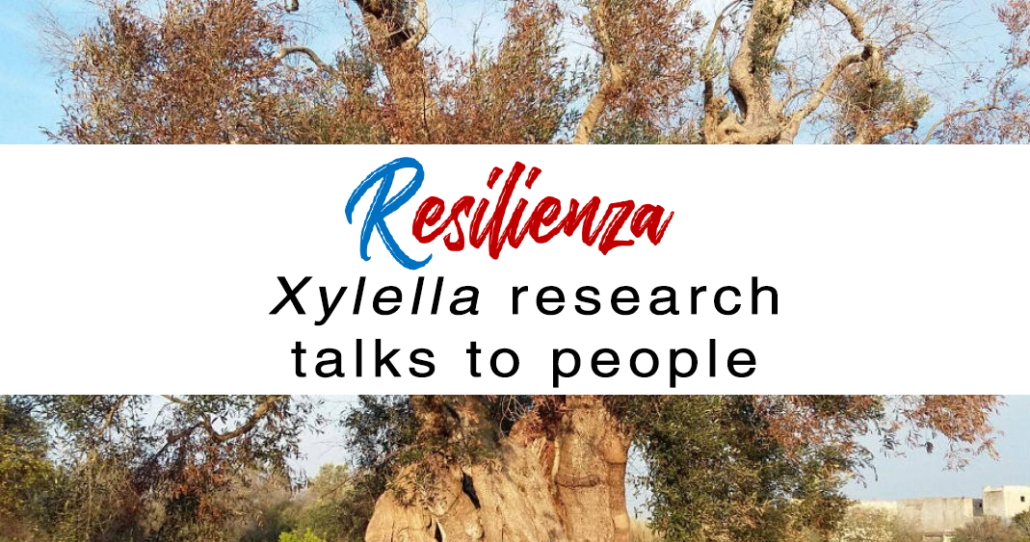
ACLI RACALE announces the congress “Resilienza: Xylella research talks to people”, to be held in Salento, in September 2019

15/05/2019/in CONFERENCES

Along with the loss of millions of olive trees across the Apulian region (Southern Italy), the introduction and relentless spread of Xylella fastidiosa caused a serious socio-cultural problem: mistrust in science and scientists involved in the research of the fastidious bacterium fomented by a consistent part of the civil society. Nowadays, a considerable number of persons either inside or outside the region where the first bacterial European outbreak was described perceive scientists as “far from the reality”, incapable of communicating their researches, pursuing something different from what would help in solving the “Xylella-problem”. Such tense climate exacerbates the gap between research and society, creating more than a problem for both the parts.

The main goal of the congress “Resilienza: Xylella research talks to people” is to begin to fill this gap: Italian scientists involved in research on Xylella fastidiosa are invited to present and discuss their work, as oral presentations or posters, during a congress that will reunite both researchers and people interested in Xylella fastidiosa and the ongoing research, including farmer associations, public institutions, schools and stakeholders.

The congress, organized within the framework of the European Project POnTE (Horizon 2020), will be held in Racale (Lecce, Southern Italy) on 19–20 September 2019.

The call for participation, with detailed information on registration and submission of contributions is available, in Italian, at this link.

For more information: resilienza.acliracale@gmail.com; danielecornara@gmail.com

Tags: ACLI Racale, Resilienza, Xylella
Share this entry
  • Share on Facebook
  • Share on X
  • Share on WhatsApp
  • Share on Pinterest
  • Share on LinkedIn
  • Share on Tumblr
  • Share on Vk
  • Share on Reddit
  • Share by Mail
https://www.ponteproject.eu/wp-content/uploads/2019/05/resilienza-congress.png 563 1069 Staff https://www.ponteproject.eu/wp-content/uploads/2016/10/PONTE-LOGO-JPEG-2.jpg Staff2019-05-15 09:34:422019-05-20 10:07:27ACLI RACALE announces the congress “Resilienza: Xylella research talks to people”, to be held in Salento, in September 2019
You might also like
Conflicting effects of climate and vector behavior on the spread of a plant pathogen
132 plants confirmed positive to Xylella fastidiosa in the Balearic Islands
WP8 meeting on plant disease risk assessment held at Wageningen University
EFSA reviews evidence on susceptibility of Phoenix roebelenii palm to Xylella fastidiosa and of citrus, holm oak and grapevine to the strain CoDiRO
A metagenomic investigation of the microbiome of Xylella fastidiosa-infected olives
A training workshop on Xylella preparedness organized by Plant Health Australia in Melbourne
Popular
  • Two upcoming courses promote innovative diagnostics for...05/09/2016 - 10:51
  • NEWSLETTER | ISSUE 23 | November 9, 201609/11/2016 - 15:00
  • Rome
    Rome kick-off meeting launched Consortium activities29/12/2015 - 11:25
  • EC.EUROPA.EU|Start of a new EU-funded project on solutions...29/12/2015 - 16:40
Recent
  • Estimating the epidemiology of emerging Xylella fastidiosa...02/07/2020 - 10:58
  • Assessment of the efficiency of different control programs...18/06/2020 - 09:51
  • A biological control model to manage the vector and the...01/05/2020 - 12:44
  • Economic impact of Xylella fastidiosa in European olive...15/04/2020 - 11:22
Comments
Tags
ANSES Apulia Ash dieback Balearics Candidatus Liberibacter Solanacearum CIHEAM Citoliva CNR CoDiRO Comunitat Valenciana Corsica CSIC Diagnostics EFSA Epidemiology EPPO EU Euphresco European Commission EuroXanth FAO Forestry Horizon 2020 Hymenoscyphus fraxineus INRA Insect vectors IPPC IVIA Mallorca Newsletter olive Olive Quick Decline Syndrome Philaenus spumarius Phytophthora POnTE psyllids SASA Spain Symptoms Transcriptome UNIBA University of Belgrade XF-ACTORS Xf tolerance Xylella

Subscribe to our Newsletter

©2025 Developed by Signum Srl
  • Link to Facebook
  • Link to X
  • Link to Youtube
  • Link to Rss this site
  • Link to Mail
Link to: EUPHRESCO network releases the final report of the PROMODE Project on monitoring and detection of Xylella fastidiosa Link to: EUPHRESCO network releases the final report of the PROMODE Project on monitoring and detection of Xylella fastidiosa EUPHRESCO network releases the final report of the PROMODE Project on monitoring... Link to: New insights into the genetic diversity of the bacterial plant pathogen ‘Candidatus Liberibacter solanacearum’ as revealed by a new multilocus sequence analysis scheme Link to: New insights into the genetic diversity of the bacterial plant pathogen ‘Candidatus Liberibacter solanacearum’ as revealed by a new multilocus sequence analysis scheme New insights into the genetic diversity of the bacterial plant pathogen ‘Candidatus...
Scroll to top Scroll to top Scroll to top

This site uses cookies. By continuing to browse the site, you are agreeing to our use of cookies.

ACCEPTDECLINEINFO

Cookie and Privacy Settings


How we use cookies

We may request cookies to be set on your device. We use cookies to let us know when you visit our websites, how you interact with us, to enrich your user experience, and to customize your relationship with our website.

Click on the different category headings to find out more. You can also change some of your preferences. Note that blocking some types of cookies may impact your experience on our websites and the services we are able to offer.

Essential Website Cookies

These cookies are strictly necessary to provide you with services available through our website and to use some of its features.

Because these cookies are strictly necessary to deliver the website, refusing them will have impact how our site functions. You always can block or delete cookies by changing your browser settings and force blocking all cookies on this website. But this will always prompt you to accept/refuse cookies when revisiting our site.

We fully respect if you want to refuse cookies but to avoid asking you again and again kindly allow us to store a cookie for that. You are free to opt out any time or opt in for other cookies to get a better experience. If you refuse cookies we will remove all set cookies in our domain.

We provide you with a list of stored cookies on your computer in our domain so you can check what we stored. Due to security reasons we are not able to show or modify cookies from other domains. You can check these in your browser security settings.

Google Analytics Cookies

These cookies collect information that is used either in aggregate form to help us understand how our website is being used or how effective our marketing campaigns are, or to help us customize our website and application for you in order to enhance your experience.

If you do not want that we track your visit to our site you can disable tracking in your browser here:

Other external services

We also use different external services like Google Webfonts, Google Maps, and external Video providers. Since these providers may collect personal data like your IP address we allow you to block them here. Please be aware that this might heavily reduce the functionality and appearance of our site. Changes will take effect once you reload the page.

Google Webfont Settings:

Google Map Settings:

Google reCaptcha Settings:

Vimeo and Youtube video embeds:

Other cookies

The following cookies are also needed - You can choose if you want to allow them:

Privacy Policy

You can read about our cookies and privacy settings in detail on our Privacy Policy Page.

Privacy Policy